
The Lakeville Chronicles
Lakeville Village Surrounds Conneaut and is Created from a Squabble over An Iron Ore Pile- 1944-1964
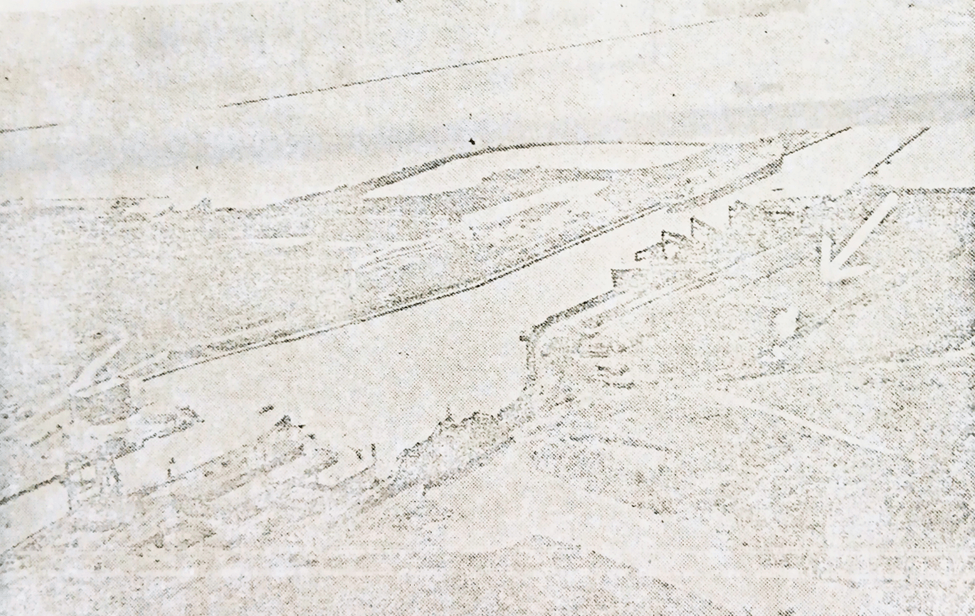
The arrow points to the iron ore piles that indirectly brought about the organization of Lakeville Ville, Ohio, west of the Erie County line in 1944. The City of Conneaut wanted the property for industrial expansion. The Township acquired tax money from the ore storage, so Lakeville was organized to keep the tax revenue from going to the city. Conneaut Harbor is outlined in the photo and the only four track swinging bridge in the world is visible.
In a story in the Erie Daily Times dated September 16, 1947, staff writer Ed Pfister tells the story of how Lakeville came to be. Ed Pfister summarizes its unusual history by writing that “it is the only village in the United States that completely surrounds a city.”
According to Ed Pfister’s version of its history, in 1944, Lakeville began as a quarrel over an ore pile. The City of Conneaut wanted more eastside territory for industrial expansion and the property that the city wanted would include Conneaut Township areas where Pittsburgh and Conneaut Dock stored its ore.
The ore piles provided Conneaut Township with tax revenue from the ore piles for its schools and other expenses. If the City of Conneaut acquired the added land for industrial purposes, it would include the ore storage land and Conneaut City would receive the taxes instead of the Township. To protect its interests, the Township officials got together and set up a village. An election took place and voters east, west, and south of Conneaut unanimously supported the annexation.
As a result of the annexation, Lakeville village absorbed East Conneaut which extends from the Pennsylvania line to the Conneaut City limits; Amboy, which is a few miles west of Conneaut; and Farnham, which is southwest of Conneaut. Lakeville Village surrounded Conneaut on every side except on the lakefront. In order to leave or enter Conneaut, people had to go through Lakeville unless they were traveling by water.
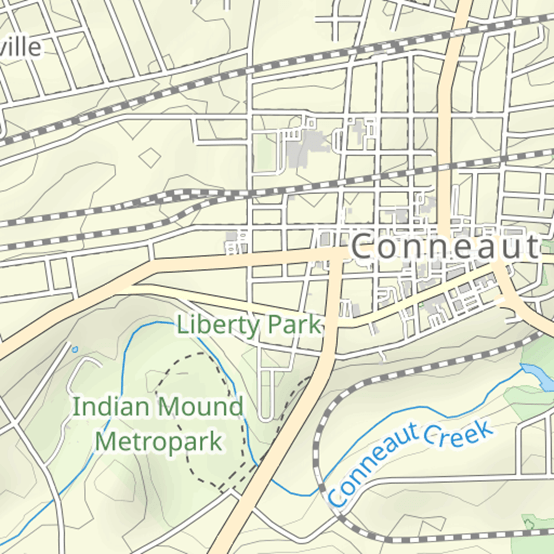
A village surrounding a city creates unusual conditions and Lakeville surrounding Conneaut illustrated that premise. Because of Ohio’s 50 mile an hour speed limit drivers traveling through the newly created cities on Route 20 and Route 5 could not exceed thirty-five miles an hour until they were within two miles of Ashtabula. That was because Lakeville’s 35 mile an hour limit started at the Pennsylvania line and extended to the Conneaut city limits and resumed at the west city limits, extending west to Kingsville, Ohio which also had a thirty-five mile an hour limit.
A village entirely surrounding a city created other peculiar conditions. George W. Britton, the mayor of Lakeville, maintained an office in Conneaut for years. Many Conneaut citizens worked in Lakeville. Conneaut Township and the City of Conneaut jointly owned the City Hall in Conneaut and mail with Lakeville addresses was delivered to the City Hall in Conneaut. Lakeville officials had two rooms in the city hall and its six-man council and city clerk, and treasurer had offices and hold meetings there. All involved anticipated a friendly court contest to determine the exact interest each party held in the building.
Conneaut City and Lakeville Village jointly supported what was formerly Conneaut’s Municipal Court presided over by Judge C.W. Appleby who had been the incumbent since the court was started in 1930. However, both towns had separate police forces. Lakeville had a five-man force of deputies under a sergeant. Lakeville had two fire departments as did Conneaut. One fire department was located in what had been East Conneaut, and the other in the west area west of Conneaut. Both towns supported Conneaut Community Park on the lake front.
Since being incorporated, Lakeville blossomed with a population of 4,200 and a total area of twenty-three miles. In comparison, Conneaut had an estimated population of 10,000 and had an area of approximately four-square miles.
Another Lakeville/Conneaut peculiarity was that no one in the village of Lakeville had filed for office in 1947 for the November election. No one running for office meant that under Ohio law all candidates for the November 4 election had to be written in on the ballot.
Although Lakeville and Conneaut both had interests in City Hall, they existed harmoniously, and the two communities cooperated peaceably in most instances. Both village and city shared fire fighting equipment and police power in emergencies, which reduced expenses for both through operating as joint municipal functions.
Both towns grew. New homes rapidly sprung up in the ambitious young city of Lakeville and building continued to increase in Conneaut which still vied with Cleveland and Ashtabula for the title of the busiest iron ore port on the entire chain of the Great Lakes.
New Litchfield, Salem, Becomes Conneaut

By Maxine Morgan, Conneaut Edition of The Times-News, Sunday March 2, 1975
Fellow citizens of Conneaut, do you know that we live in a community which for awhile back in the early1800s was called New Litchfield?
The name according to the Reverend Rufus Clark, pastor of the South Ridge Baptist Church who wrote a handwritten history of this area in 1880, was chosen because one of the early settlers here, Seth Thompson, came from Litchfield, Connecticut.
New Litchfield was not popular with most of the settlers even though the majority of them did come here from Connecticut, for another name was soon to be used.
Reverend Clark wrote, “The name Salem came to be the recognized cognomen soon afterward, and the borough included a township and a half (embodied the north half of what is Monroe Township.)
“During the winter of 1832-1833, a petition was circulated among the citizens which was almost universally signed to have the name changed to Conneaut.”
An Act of 1837 was passed, and the borough became “CONNEAUT”, so named after the Indian name Conneaut River, meaning River of Many Fish.
With preparation underway for the local observance of our country’s Bi-Centennial in 1976, many history buffs are searching out any records of this city’s early days. Conneaut has the distinction of being the spot where Moses Cleaveland (too often misspelled as Cleveland) and his party landed and celebrated Independence Day July 4, 1796.
Conneaut is the entrance to the Western Reserve of Ohio.
 Home
Home 