
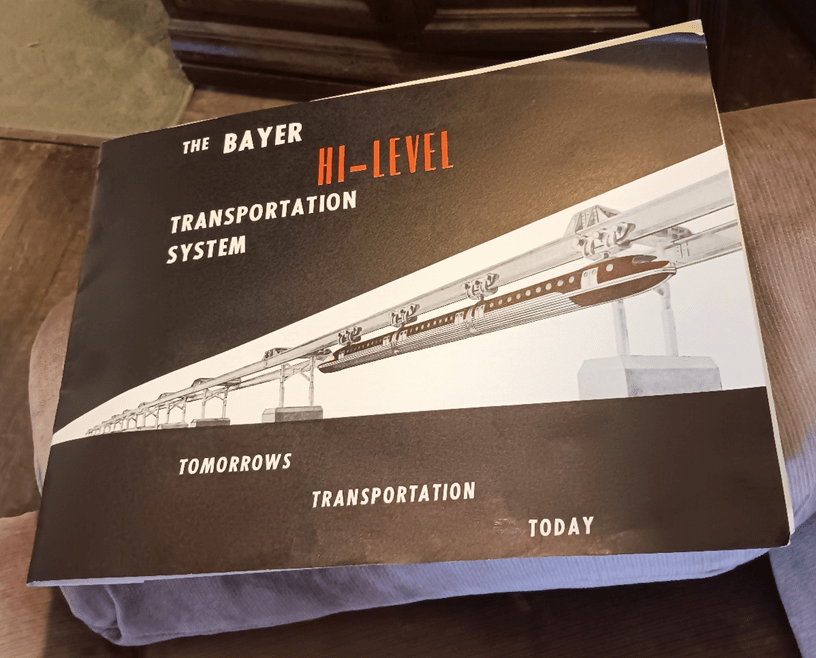
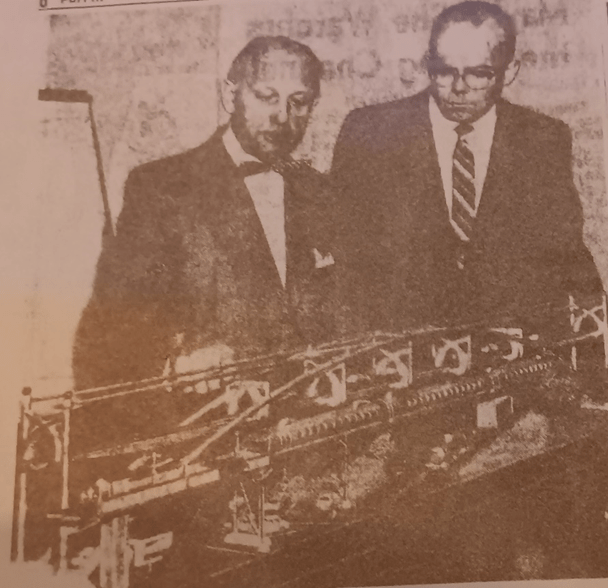
Jeff Morrell, Jerry Janco, and Matthew C. Bayer are three of the important main characters in Conneaut’s part in the monorail story, with the monorail itself being the perpetual main character. Jeff Morrell, President of the Conneaut Railroad Museum, donated a scale model of the Bayer Hi-Level Transportation System to the Conneaut Historical Museum. Jerry Janco, Museum Vice-President gladly accepted the model from the Railroad Museum. Matthew C. Bayer, created his prototype model and the documentation that arrived with imagination and perspiration.
Monorails Travel Like Airplanes and Conneaut has a Model Monorail
Born on Christmas Day, 1905, in Minneapolis, Minnesota, Matthew absorbed the music of the whistles of the steam trains chugging through the railroad yards and the culture of a railroad worker, because his stepfather Lewis Faubert was a yard master on a steam railroad. Matthew enjoyed a working relationship with trains and their constitutions, care, and feedings, and chose mechanical engineering, including the mechanics of trains, as his career.
Matthew C. Bayer

Matthew’s resume reflects his varied interests and educational and work qualifications for creating a monorail system. He graduated from the University of Minnesota with a degree in mechanical engineering and from the Dunwoody Institute in Minneapolis with a technical degree. He successfully completed a Transport Pilot Course at the Pacific School of Aviation in Santa Monica, California.
His field engineering experience included:
- work on the Atlas Missile at the General Dynamics Astronautics, Convair Corporation, San Diego, California.
- A.O. Smith, Milwaukee, as a senior design engineer on the Mechanical-Aeronautic B-52 bomber.
- J.S. Thermo Corporation, Minneapolis, Minnesota, project engineer as a railroad reefer and truck refrigeration.
- Chicago, Milwaukee, and St. Paul Railroad as a construction engineer and superintendent rebuilding the depot.
During the Great Depression, Matthew earned $7.50 an hour as a mechanical engineer in Hollywood’s movie studios.
In his spare time, Matthew produced art and played the organ, but trains dominated his intellectual activity, to the degree of planning a monorail system and presenting his ideas to whoever would listen, including city officials from Los Angeles and San Diego.
For centuries, elevated trains and monorails have existed in different profiles and places. New York City had an elevated rail system in the 19th Century. Walt Disney introduced a monorail in his EPCOT and Magic Kingdom theme parks to name just a few in the United States. Japan has the most successful monorail system, carrying about one hundred million passengers a year. Matthew Bayer believed that the United States could create the same successful monorail system. Encouraged by The Urban Mass Transportation Act of 1964, that President Lyndon Johnson signed into Law on July 9, 1964, Matthew Bayer spent at least twenty-five years developing his monorail transportation system.
In a Los Angeles Times story of November 12, 1959, Matthew explained his railway plan to David Miller of the Metropolitan Transit Authority.
Matthew’s elevated railroad would be supported by 1.000-foot cantilevered arches that would support aerodynamic trains traveling 250 miles per hour. Christening his invention “The Elevated Speed Rail System,” Matthew declared the government could build a 14-mile test line to carry missiles from a standard railroad to a launching site. Operating more peacefully, his railroad could be a mass transit system carrying passengers and freight.
The superstructure of the elevated railway would be built entirely of steel and could be built for less than one million dollars a mile, according to Matthew. He proposed individually powered cars in three car sections hung beneath the standard rails. Each car would carry 176 passengers sitting three abreast of each side of the aisle. Special seats would be required, he conceded, because his streamlined suspended trains could accelerate to 150 miles an hour in thirty seconds.
Matthew also proposed the innovation of building steel bedded highways atop the superstructure of the railroads which would rise fifty-five feet above the ground.
As proponents of numerous other rapid mass transit systems, Bayer made his presentation to representatives of Daniel, Mann, Johnson & Mendendall, under contract to MTA to evaluate the various proposals.
Matthew Bayer discussed his monorail project with many newspapers including the San Diego Union, The Los Angeles Times, The Los Angeles Examiner, the Minneapolis Tribune, the Minneapolis Star Journal, the Chicago Tribune, the Milwaukee Sentinel, and the New York Times and New York Mirror. He presented his project on CBS television stations in San Diego, New York, Minneapolis, Chicago, and Los Angeles. His monorail plan attracted much interest and discussion, but ultimately Los Angeles officials who had seriously considered it, decided against the plan because they felt the taxpayer would lose in the end.
Two more political reasons for their decision were the fact that two powerful political forces in Los Angles opposed Matthew Bayer’s plan, Pacific Electric Lines (the Red Car) and the Los Angeles Transit Lines. The Los Angeles Transit Lines was run by National city Lines which was partially owned by General Motors. They proposed a series of express buses along the Freeways.
The public’s love affair with the automobile and politics are two major reasons why monorails have not gotten much traction or track in the United States. Other pros and cons of monorail systems are:
Advantages
- Monorails require minimal space, both horizontally and vertically. Monorail vehicles are wider than the beam, and monorail systems are commonly elevated, requiring only a minimal footprint for support pillars.
- Due to a smaller footprint, they are seen as more attractive than conventional elevated rail lines and block only a minimal amount of sky.
- They are quieter, as modern monorails use rubber wheels on a concrete track.
- Monorails can climb and descend to steeper grades than heavy or light rail systems.
- Straddle monorails wrap around their track and are not physically capable of derailing, unless the track itself suffers a catastrophic failure, which is why monorails have an excellent safety record.
Disadvantages
- In an emergency, passengers may not be able to immediately exit because the monorail vehicle is high above ground and not all systems have emergency walkways.
- The need for the track to be completely elevated.
- Costly parallel maintenance infrastructure.
- Low capacity compared to heavy rail and light rail.
 Home
Home 