
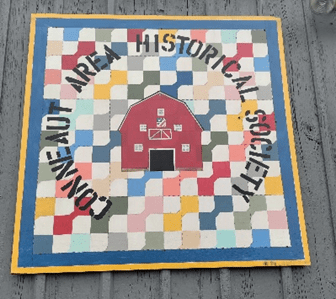
Last fall, Conneaut Area Historical Museum Steering Committee Member Debbie Herbel painted our museum Barn Quilt and it is proudly displayed on the front of our museum. We are thrilled to be a square in the Ashtabula County Barn Quilt patchwork and a traveler on the Ashtabula Barn Quilt Trail.
The barn quilts celebrate Ashtabula County’s agricultural heritage, including the Underground Railroad network, natural areas preservation, and Great Lakes maritime history. Barn quilts stretch from the Ashtabula Lighthouse to the Pennsylvania borders and into Lake and Trumbull Counties. Theses trail guides take visitors to the heart and stories of Ashtabula County history. More than 110 barn quilts on both public and private buildings display the tourism and historical attractions of Ashtabula County. For more about the history, purpose, and quilt creators of the Barn Quilt Trail, go to their website at Ashtabula County Barn Quilt Trail
We plan to expand our Barn Quilt by using our historical collections to create a notebook library of Quilt Squares featuring people, places, and events in Conneaut and Ashtabula County history. If you would like to contribute material for a quilt square, please contact a member of the Steering Committee.
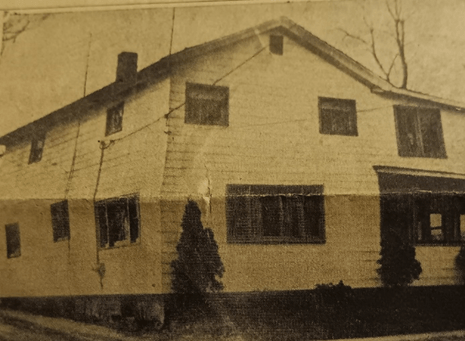
441 Harbor Street
Alanson P. Tubbs
Charles F. Graham
Sunday Baseball Father Lived in Harbor Street Home
Although this house at 441 Harbor Street has changed its exterior appearance in the past century, its history is recorded in the abstract of title. The home has been occupied for the past twenty years by Mrs. Margaret Pizzi and her family.
Saturday, March 25, 1967
Margaret Schmidt, News-Herald Reporter
Among those who have owned the property at 441 Harbor Street since 1841 were a ship’s captain and a railroader. The railroader was also known by his friends as “father of Sunday baseball in Ohio.”
An unusual experience recently turned the News Herald’s attention to the home. In answering a knock at the door, its present owner, Mrs. Margaret Pizzi, was confronted by a stranger. The man from out of town introduced himself and stated a relative of his had lived there and he had a desire to once more see the inside. Mrs. Pizzi paid little attention to the visit and soon forgot the man’s name. But the series of old homes began to appear in the paper , and since the visitor was an older person, she began to wonder about the age of their home.
The man had told her the house once stood farther south of the tracks, but had been moved. He also said Harbor Street was a mere lane at that time. So Mrs. Pizzi turned to the abstract of title for some dates. On April 14, 1841, for the price of $1,000, a warranty deed was passed from John H. and Mary D. Hall to Alanson P. Tubbs. The property was listed as one-sixth of an acre situated on the west side of the road leading from Lyon &Gould’s Store to the lake. It was further noted Mr. Hall had bought the property from L. Lake.
The next transaction, recorded in 1916 by Charles F. Graham, stated that he was the grandson of Alanson Tubbs. According to the statement, Mr. Tubbs died August 6, 1874, leaving six heirs. Henry C., Cyrus W., and Wallace Tubbs, Esther Ann Devore, Harriet Snow, and Addie J. Graham.
The News-Herald file was searched for the death announcement of Mr. Tubbs. According to this record, Captain Alanson P. Tubbs, age 69, died at his home. He was born in Conneaut and at the time of his death was one of its oldest inhabitants. He followed the lakes most of his life, the story said,
Quit claim deeds of Adelia Graham were signed by five of the heirs and their spouses. This is recorded in 1876 and 1877. B.F. and Addie Graham sold to Charles F. Graham in 1893. Mr. Graham died in December of 1918. Announcement of his death was preceded the day before by word that he was seriously ill in Grace hospital.
“Charles Graham was often proclaimed by his friends as “Father of Sunday baseball in Ohio” through his activities on behalf of the law which gave to communities the right to have the sport if they desired,” the news story reported.
Mr. Graham, a railroad man, spent much of his time in Columbus as a representative of a conductor’s association. The following day, December 21, 1918, the edition carried the news of his death and noted that he was born April 13, 1864, at the family home on Harbor Street. His body lay in state at the home, 441 Harbor Street. Among his survivors were three sons: Frank, Clyde and Dickson, and a daughter Minnie, who all signed off to a Charles E. Deyo. The Deyos sold to Charles B. O’Brien and he to F.H. Jones. It was in 1946, Herman and Bessie Caslor and Margaret K. Caslor, who is now Mrs. Pizzi, bought the home.
A great deal of remodeling has taken place in the past thirty years, Mrs. Pizzi states. Large rambling porches have been done away with and the home is now a duplex.
From history buffs comes the indication that Harbor Street, once known as “the Old Salt Road,” was built in 1804. The first track of the settlers of Ohio lay much of the way along the beach of the Lake, and sometimes the wagons of our fathers ran deep in the sands and its waters. The first regularly surveyed highway was The Ridge Road along Liberty Street in 1800 by Nathan King, first surveyor, and Seth Harrington and Aaron Wright. It was cut open as far as Ashtabula.
The next one, styled “The Old Salt Road,” because it was cut through for a track over which to draw salt, was started from the harbor in 1804, and ran in a southern irregular direction through several towns of the “first range,” one historian wrote.
Dr. Greenleaf Fifield and Captain Ananson Tubbs
According to the biography of Greenleaf Fifield in the Williams Brothers History of Ashtabula County, Dr. Greenleaf Fifield possessed a strong physique, towered to a height of over six feet tall, and had a balanced, resolute outlook and a calm temperament. For nearly thirty years, he faithfully doctored the people of Conneaut and Ashtabula County. Like other physicians of his time, he did not bill people but traded his services for practical items like food, tools, or whatever his clients could pay.
Dr. Greenleaf Fifield also had a sense of humor and fun, and liked to participate in practical jokes. A witness to one of Dr. Fifield’s jokes told his story to the Williams Brothers who included it in their Ashtabula County history. Dr. Fifield and Captain Alanson Tubbs played the leading roles in the story. Captain Tubbs was one of Conneaut’s most stalwart and well-known sailors. One day Captain Tubbs encountered the good doctor on a Conneaut street and consulted him about a minor complaint including a sore chest. Dr. Fifield told him to apply a big hemlock gum plaster to his chest. The Captain followed the Doctor’s orders, but forgot to shave the hair off his chest before he covered the entire front of his breast with the hemlock gum plaster. For a short time, the Captain felt relief and there was no soreness in his chest. Then as is the way of hemlock plasters, it began to provoke his skin to an intolerable itch. As the Willaims telling of the story put it: “The man who puts on that kind of a plaster to please himself will be pleased twice – when he gets it off, especially if he forgets the preliminary shave.”
Captain Tubbs, courageous mariner who braved the wind and waves of Lake Erie and its companion lakes, could not summon the courage to pull the plaster away from so much hair so he suffered the consequences of his inaction. For several days he went about his daily life and rounds about town itching and grumbling and trying to find a painless way to get rid of the gum plaster.
After days of Captain Tubbs sharing his loud, embellished suffering laced with sophisticated sailor swearing with his family, friends, and Conneaut at large, he confronted Dr. Fifield who had parked his gig in front of one of the Main Street hotels. A crowd quickly gathered to witness the confrontation between the doctor and the sailor. Dr. Fifield immediately realized that the hemlock plaster had to be removed and formulated an on-the-spot plan to swiftly and humanely remove it. His plan involved great physical effort by the captain and focusing his attention elsewhere to make him forget the miniscule pain.
Dr. Fifield called Captain Tubbs over behind his gig and leaning over the side, carefully uncovered the plaster. Quietly and quickly he gripped the top of it and tapped old White, his horse, with his whip. Old White sprang into a run, and Captain Tubbs had to follow. Down the street they flew, but even Captain Tubb’s long legs could not keep up with Old White. The plaster flew off almost abreast of Captain Tubbs.
For years after the race, Captain Tubbs told the story, laughing until he cried. He always said that he had no sooner thrown a big stone at Dr. Fifield than he prayed that the stone would not hit him, because it would have gone through him if the Captain’s aim had been true. Captain Tubbs hugely enjoyed being rid of his large hemlock plaster, but he believed that the joke lasted much longer than the plaster. If he now quietly ventured into town, the tavern patrons and other bystanders would inquire about the plaster. Captain Tubbs estimated that he paid for about five gallons of whisky by the glass, before other stories replaced the story of the hemlock plaster.
The source for this story is: Sketches of its Pioneers and Most Prominent Men by Publ. Philadelphia – Williams Brothers – 1878 – Page 127
Captain Tubbs is buried in City Cemetery with his wife and son. His daughter Adelia married Charles F. Graham. Charles F. Graham is buried in Glenwood Cemetery. Charles Graham worked for the Lake Shore & Southern RR and also was a dock foreman according to Ancestry records. His involvement and influence on Conneaut baseball mentioned in the newspaper article has yet to be fully researched.

